

Bruna: “We want to make our food system future proof”
What if you copy nature as much as possible while farming? And thereby you improve the soil, restore biodiversity, capture CO2 and develop a productive agricultural system? That is syntropic farming in a nutshell. Syntropic farming is already practiced in for example Brazil, Portugal and Tanzania. De BosBoerderij introduces this method on a commercial scale in the Netherlands. Together with landowners, they develop syntropic farms and train forest farmers. Bruna San Roman, co-founder of De BosBoerderij tells us about their work.
Creating new food systems that work with nature
De BosBoerderij develops and runs syntropic farms for ecosystem restoration. In syntropy, farmland becomes a fertile, lush and green landscape. De BosBoerderij builds a productive forest landscape that restores water cycles, nutrient balance and soil life. This is a way of farming that follows the ideas of regenerative agriculture. Both focus on working with nature to make the soil healthy and grow food in a way that helps the environment.
Bruna: “With our activities, we prototype regenerative ways of relating to food and ecosystems, with the vision of changing the current food system. In all aspects of our food system, from farmland to market, things can be improved for the future. For example, we want to motivate people to eat food that comes from a forest environment, like chestnuts.”
An intrinsic wish to restore agriculture
Bruna worked as a product owner for a software company for hotels, before she decided to follow her intrinsic wish to restore agriculture. “I saw myself using my talents for a solution that is profit driven. With the climate crisis and all the problems with nature, I decided to use my time and energy to help solve this crisis.” She started following courses about ecosystem restoration and saw how people grow food in an regenerative way. “I was like; this sounds really good. I want to do this for life!”
Bruna met the other co-founder of De BosBoerderij, Suzanne van der Velde, during the Fresh Ventures Studio program. “I joined the team that investigated how syntropic farming can be a solution. Suzanne came up with an idea how we can do agriculture restoration. We both felt in love with the practice and developed our skills. We have the same vision and drive to change the food system.”
Belief in the concept
During their first year, Bruna and Suzanne worked on building evidence for their concept. “When you start, you need to build some sort of proof. So that people really want to listen to your story and support you.” The DOEN Foundation was one of the early believers in De BosBoerderij. “When they said ‘yes, we believe in your plan and are going to fund you’; that was such a big gift. Other funders – who might not fully understand what we’re doing – now had a reason to also look at what we’re doing.”
A crucial role for people
De BosBoerderij is now in its second year and has two syntropic farm plots; one demonstration plot near Leiden, and a second plot in Wassenaar. “This is a larger and more productive plot with an operations team running it.”
De BosBoerderij manages the plots together with the farmer or land owner. Bruna and her team believe that people play a crucial role in regeneration, making land future proof: they plant, prune, manage and harvest, and this motor of engagement is what regenerates the land faster. It is an innovative agricultural method that reconnects humankind with nature.”


The beauty of nature
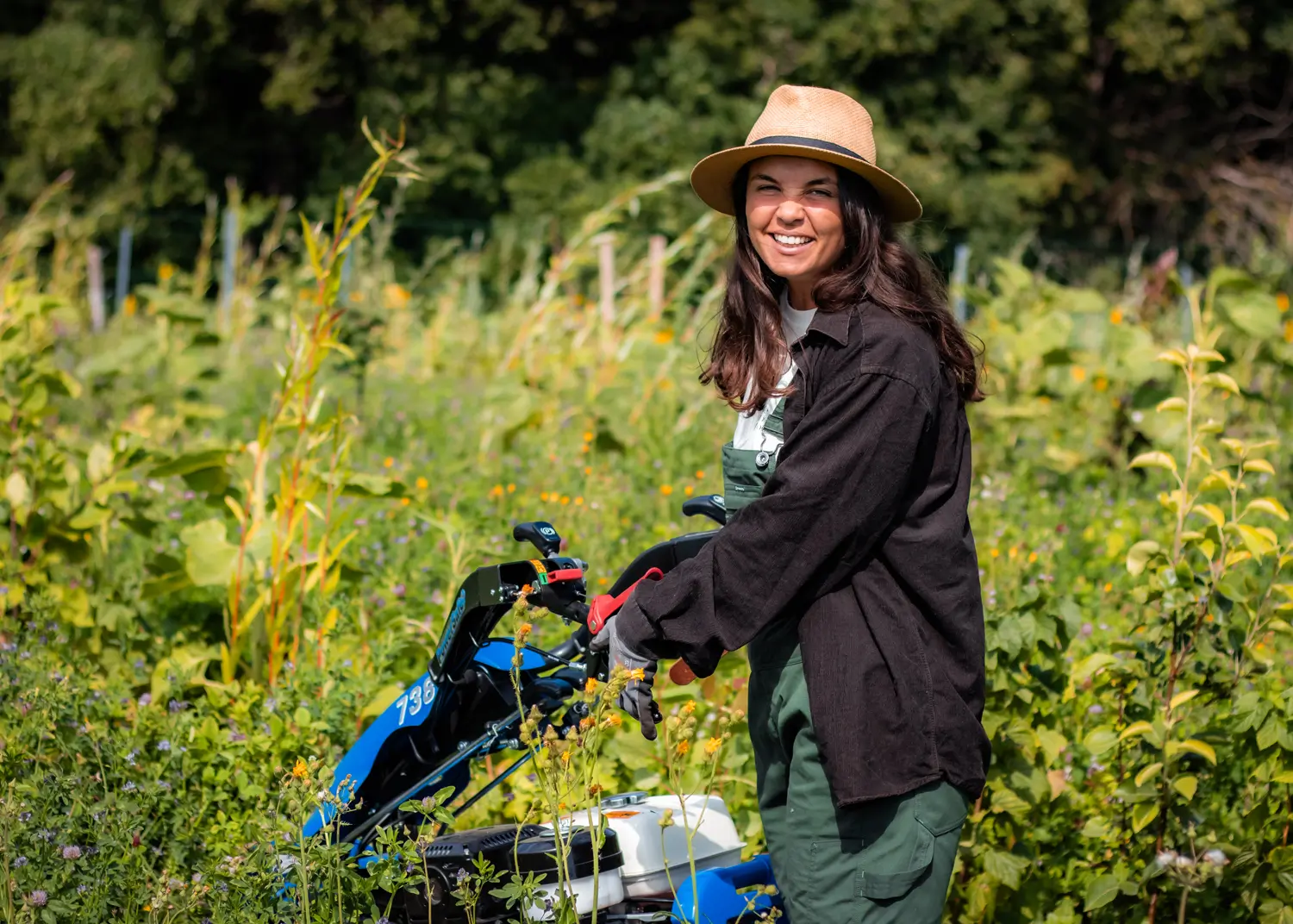
“Finding the group of financiers that understand our mission and believe in it, is one thing I’m proud of. I’m also proud of the people that joined our course and now continue on the path of syntropic agriculture.” But Bruna is also very proud of the farm plots they planted. “Our land is so beautiful. How the vegetables and herbs are growing. One can see the results of an ecosystem-based way of growing vegetables: there are no pests, no diseases.”
The mission continues
Bruna and her team have many plans for the future. They’re looking to expand the existing plots and develop new ones. “We want to do that in a strategic way and work with the natural processes. By collaborating with scientists, we can monitor the ecological impact, soil health and more.”
Thereby, De BosBoerderij also wants to develop other, traditional farm models with a syntropic approach. “So not only working with food forests, but also, for example, work on large-scale fruit or dairy production.” And last but not least, they want to offer ways for people to learn to become a BosBoer with a year-round program. “We already offer online masterclasses and one-off training courses, but together with specialists, we want to launch a larger program next year.”
Start with whatever you have
“Don’t make it too complicated in your head. You can start with whatever resources you have.” That’s what Bruna wants to say to people who also want to make an impact. “You can start for example by working on a regenerative farm on Saturdays, or by helping to collect trash from the seas.” And if you’re unhappy with your career? Bruna invites you to come work in the impact industry. “We really need good people who can help us, and do work that matters to build a regenerative future!”
The DOEN Foundation supports De BosBoerderij thanks to the players of the Nationale Postcode Loterij.