
Ending throwaway culture
The world produces more than 400 million tons of plastic each year. More than a third is used for packaging, much of which is discarded immediately after use. The throwaway mentality is still deeply embedded in our society. Enviu, the Fair Resource Foundation and Natuur & Milieu decided tackling the plastic problem meant changing that attitude. So they started the Mission Reuse project in 2020 to make reusable products the norm in everyday life. The DOEN Foundation has supported Mission Reuse from the beginning.
Working together to drive reuse
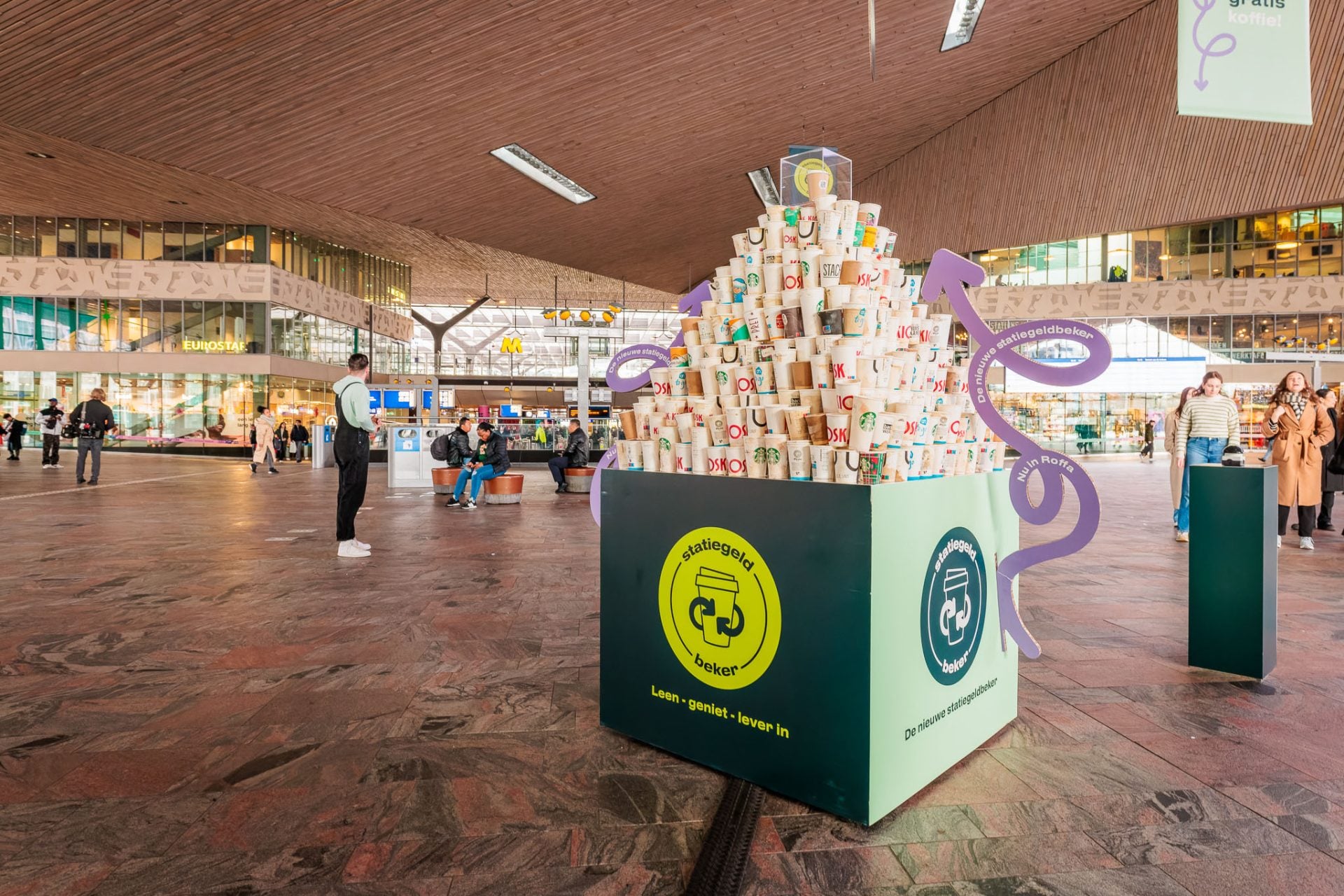
How do you change deep-seated habits? Mission Reuse aims to find out by testing reuse at various locations where a variety of people congregate, including offices, sports clubs and public transport. The organisation started a pilot project in spring 2024 with partners including NS (the Dutch national railway company), the municipality of Rotterdam and the province of Zuid-Holland. For three months, 30-plus food and beverage partners around Rotterdam Centraal Station experimented with a collective reusable–cup return system. A few key insights emerged:
– Cooperation and a consistent approach among participating businesses are crucial for convincing consumers.
– A universal return infrastructure is not only technically feasible, it works well in practice.
– Reuse skyrockets when it’s offered as the default option.
More people on the same page
So good cooperation is essential for phasing out single-use packaging. Big steps need to be taken. The will is there, but what’s the best route?
To facilitate knowledge-sharing and enable stakeholders to connect and inspire each other, Mission Reuse has been organising the Reusable Packaging Fair since 2023 in cooperation with the Netherlands Institute for Sustainable Packaging, Verpact, and the Dutch Ministry of Infrastructure and Water Management. Policymakers, innovative start-ups and members of the business community attend the fair. After years of lobbying by Mission Reuse to persuade politicians to prioritise reuse and the circular economy, a change in mentality has become clearly noticeable at the fair. The question is no longer whether the Netherlands will make the switch to reusable packaging, but how.
“Thanks to DOEN’s support, reuse is now firmly on the agendas of government and business as well as funding providers, and implementation is truly under way. Parties that weren’t engaged in reuse before are now looking at how they can get involved.” – Dieuwertje Nelissen, Chief Programme Officer, Enviu
Cinema group takes the plunge
Will we ultimately be able to dispose of the throwaway economy? According to Enviu, we can only achieve this if everyone does their bit: the government by amending laws and regulations, companies by changing their systems and services, and consumers by being prepared to go the extra mile. But it’s certainly possible, as demonstrated by the Pathé cinema chain. Supported by Mission Reuse, Pathé tested a sustainable reuse system in a successful pilot project at three locations, saving around 45,000 disposable cups and 25,000 lids in three months. The company took the plunge during the 2023 Christmas period and introduced reusable cups in all 30 of its theatres, which will save an estimated 1.8 million disposable cups a year. Pathé is sharing the knowledge gained with other organisations to help them to take their first steps with reuse.
“The Mission Reuse programme is playing a key role in shaping and accelerating the reuse transition. They’re driving change in various ways – influencing policy, encouraging innovation, implementing change in big organisations. The pilots show the success of their approach, so it’s crucial that Mission Reuse is able to continue to build on this in the coming years.” – Maaike Broekhuis, Regenerative Economy Programme Manager, DOEN
Packaging with a future
Mission Reuse is working hard to tackle the packaging reuse challenge using a comprehensive approach. As well as initiating, encouraging and scaling up innovative solutions (and expanding their efforts to e-commerce and glass), they’ve placed reuse firmly on the national and international political agendas. Mission Reuse connects its partners and shares best practices and knowledge gained, so that more and more people realise reuse is the way forward.
“It’s great, and so important, that Mission Reuse is championing reusable packaging! It’s led to significant growth in support for reusable cups and other consumer packaging in the last few years. We hope to be able to achieve something similar with commercial and transport packaging in the near future.” – Bowine Wijffels, transition manager for plastics, circular economy programme, Zuid-Holland province
DOEN’s role as an incubator
Innovative initiatives that are still in their early stages aren’t yet eligible for support from the VriendenLoterij or Nationale Postcode Loterij. Projects like these can grow in DOEN’s incubator until they’re ready to take flight and, in some cases, end up in the warm nest of one of the lotteries. That’s what happened to Enviu, one of Mission Reuse’s parent organisations. After three years of DOEN support, Enviu received a €500,000 grant from the Nationale Postcode Loterij in 2024 – a huge boost for its continued growth and development.
More support for less waste
In 2024, within its Regenerative Economy theme, DOEN funded various partners focusing on waste reduction. Alongside Mission Reuse, organisations like BikeFlip, Lena the Fashion Library, and Pakt are committed to promoting reuse. Every month Pakt cleans 250,000 used glass and plastic containers. Others are opting for smart waste processing; they include Byewaste, the plastic–recycling technology developer Veridis, and Oscar Circulair, which collected almost 4 million kilos of separated commercial waste in 2024. Still others are finding different types of solutions: Humade designs attractive repair products, such as a kintsugi kit; PeelPioneers processes citrus peel into high-quality ingredients; Orbisk helps prevent food waste by tracking kitchen waste streams.